GitHub Issues alternative

A friendlier GitHub Issues alternative for customer suggestions.

GitHub Issues keeps technical work close to the code. SuggestionBox.io gives customers a branded place to share and follow product Suggestions while your private repository and engineering workflow stay yours.

The short version

Should customers enter the repository or a product space?

GitHub Issues and SuggestionBox.io can both hold product ideas. One is built around the repository. The other is built around the customer conversation.

GitHub Issues may already be included in the GitHub workflow you use. SuggestionBox.io costs $5 per month to provide a separate public experience built specifically for customers.

Choose GitHub Issues when you need

Developer work tracked beside the code

  • Issues connected to commits, pull requests, projects, labels, and milestones
  • Powerful search filters built around qualifiers such as “is:issue state:open”
  • A technical workflow for implementation details, bugs, tasks, and engineering discussion
Read the GitHub Issues documentation

Choose SuggestionBox.io when you need

A friendly public board for customers

  • A branded public board separate from your private code repository
  • Plain-language search with visible type, status, and sort controls
  • Clear people counts, comments, verified participation, official responses, and updates
Open the read-only demo

Side by side

Keep customer suggestions separate from engineering work.

GitHub Issues and SuggestionBox.io can complement each other. One can be the team's technical system of record while the other is the customer's public front door.

Detailed comparison of GitHub Issues and SuggestionBox.io
Question GitHub Issues SuggestionBox.io
Primary job Plan, discuss, and track bugs, tasks, enhancements, and implementation work inside a repository. Collect public product suggestions, show customer demand, and communicate product decisions.
Repository visibility Issues in a public repository can be public. Issues in a private repository are limited to people with repository access. The public suggestion board stays separate from the codebase, so customers can participate while the repository remains private.
Best audience Developers, technical users, and open-source contributors who are already comfortable working in GitHub. Customers with any level of technical experience, including people who do not otherwise use GitHub.
Participation A participant uses a GitHub account, enters the repository's Issues area, and follows its issue form or template. Anyone can browse; submitting, expressing interest, or commenting uses private email verification without a password.
Finding a suggestion The search box supports powerful qualifiers such as “is:issue state:open,” and precise combinations can require users to know or look up the query syntax. Customers type ordinary words into Search suggestions, then use visible Type, Status, and sort menus; there is no query language to remember.
Understanding demand Labels, issue types, milestones, projects, sub-issues, dependencies, and search organize engineering work. Searchable suggestions, verified people counts, comments, and duplicate handling show where customers share the same request.
Engineering workflow Issues can reference code, connect to pull requests, and close automatically when linked work is merged. SuggestionBox.io does not replace or sync with GitHub Issues; move accepted work into your engineering tracker on your terms.
Customer experience The experience uses GitHub's repository structure, identity, terminology, and visual design. Customers see your product name, logo, public theme, and a focused suggestion workflow on a hosted subdomain.
Customer support value Issues can support people who already have repository access and understand GitHub, especially for open-source projects and technical troubleshooting. Feature requests, bug reports, comments, and official responses create a public product-support channel where one answer can help every customer following the same request. It is not a private help desk.
Closing the loop Issue state, labels, comments, assignments, and GitHub notifications communicate activity to participants. Five public statuses, official owner responses, and subscriber emails explain what the product company decided.

Keep the engineering workbench

GitHub Issues belongs beside the code.

SuggestionBox.io does not replace or synchronize with GitHub Issues. When a public Suggestion becomes real engineering work, your team decides what to carry into the repository and how to implement it.

Code relationships

Issues can connect directly to commits, branches, pull requests, projects, sub-issues, and dependencies.

Technical detail

Templates, labels, issue types, milestones, assignments, and discussions support the precision developers need.

Open-source communities

When the repository is public and customers already use GitHub, Issues may be the most natural shared place.

The customer front door

Give customers an interface built for them.

Customers can search, participate, comment, and follow product decisions without repository access or a GitHub workflow.

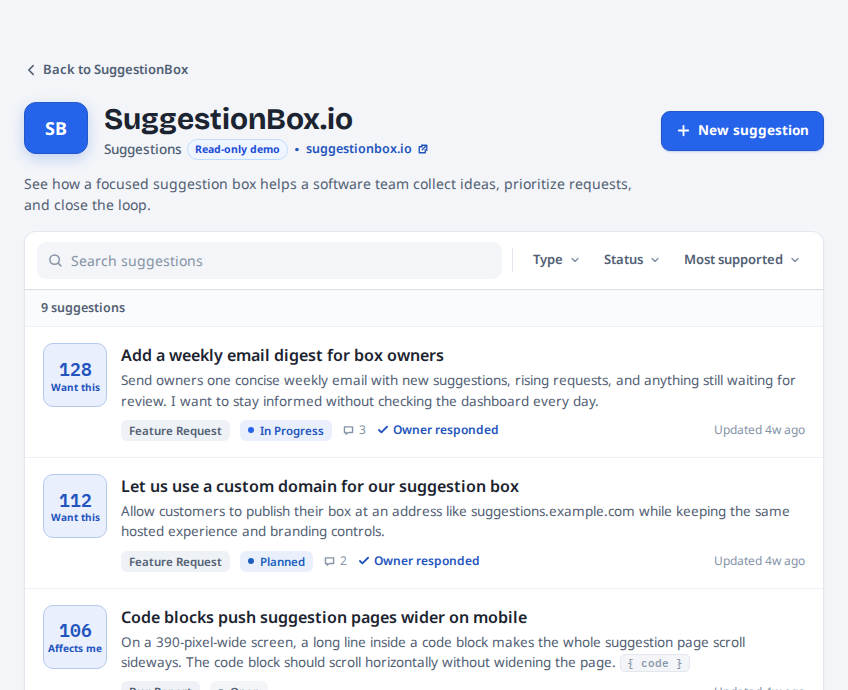
A populated SuggestionBox.io Suggestions portal with search, participant interest, statuses, comments, and official responses.

Pricing and access

The free option may be the right option.

If every participant already uses GitHub and the repository can be public, another tool may be unnecessary. But many software products are not open source. SuggestionBox.io gives their customers a public, user-friendly place to suggest improvements without exposing the code, granting access to a private repository, or learning a developer workflow.

Current provider pricing

GitHub Issues

GitHub Free includes unlimited public repositories and unlimited private repositories with a limited feature set. Issues follow the repository's access boundary, so customers cannot participate in a private repository unless you grant them repository access.

Focused paid plan

SuggestionBox.io

The $5-per-month or $50-per-year Founder Plan provides one branded, user-friendly public box for collecting unlimited customer suggestions and expressions of interest while your code repository stays private. Customers get an interface built for them; GitHub can remain the team's engineering tracker.

Sources: Competitor details were reviewed on September 2, 2026 from GitHub Issues overview, creating an issue, filtering and searching issues, repository visibility, GitHub accounts, GitHub pricing. Features and plans can change, so verify current requirements with the provider.

Keep the repository private and the customer door open.

Create your SuggestionBox, share one link, and move accepted work into GitHub on your terms.

Create your suggestion box